A system with five states is in equilibrium at temperature . The energies fulfill . What values does the system’s entropy take for and ?
A box of volume contains an ideal gas in equilibrium at temperature . The gas is now isothermally expanded to volume . Find the ratio between the average speeds of the particles before and after the expansion.
You have two classical ideal gases, one consisting of atoms, the other consisting of diatomic molecules. Which gas has the larger heat capacity? Give a short explanation for your answer.
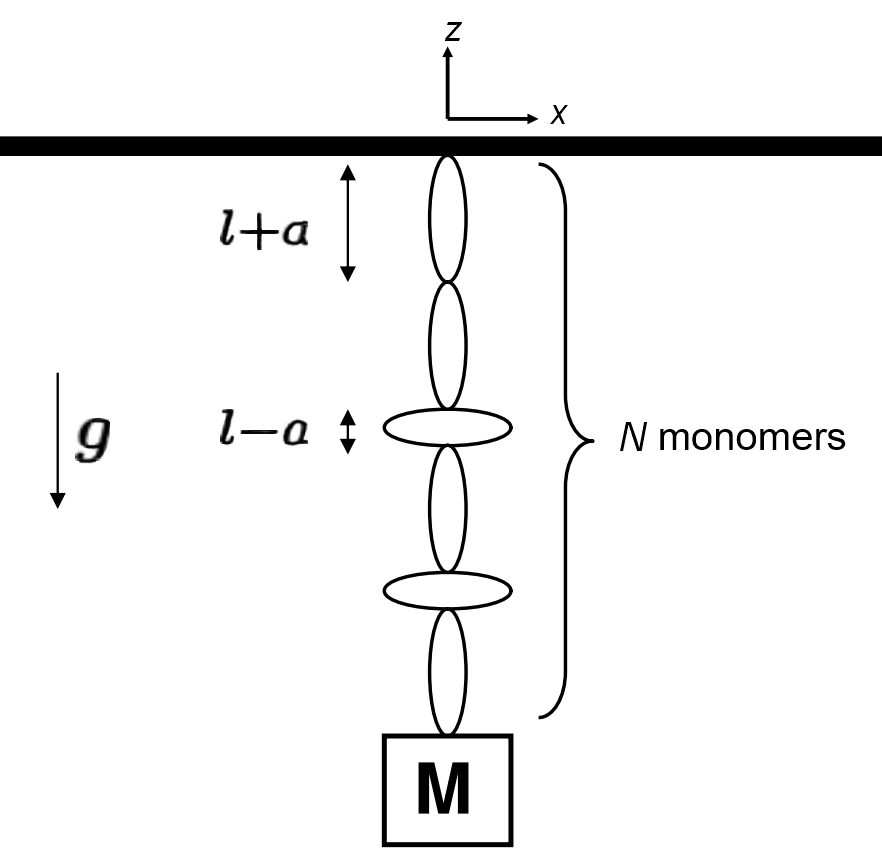
A model of a polymer is formed by connecting
ellipsoid-shaped molecules into a one-dimensional chain.
Each molecule has two ways of connecting to the polymer
(see figure). It can align either its long axis (length
)
or its short axis (length )
with the direction of the chain. One end of the chain is fixed
at the ceiling, while the other holds a mass M (see figure).
Gravity is acting along the negative z direction.
Neglecting the mass of the monomers, the energy of a given state of the polymer can be written as
where is either or , depending on the orientation of monomer . The system is in equilibrium at temperature .
Calculate the single-monomer partition function .
Find the partition function of the polymer chain, its free energy , and its internal energy .
Compute the average vertical distance between the fixed end of the polymer and the mass as a function of , , , , and .
Analyze your result for in the limits of and .
continued on next page
A rubber band has the equation of state where is its length, is the tension force, is temperature, and is a constant. The internal energy is given by where the heat capacity at fixed length is a constant.
Consider a heat engine using this rubber band. The cycle consists of an isothermal shrinking (A B), a cooling at constant length (B C), an isothermal stretching (C D), and a heating a constant length (D A).
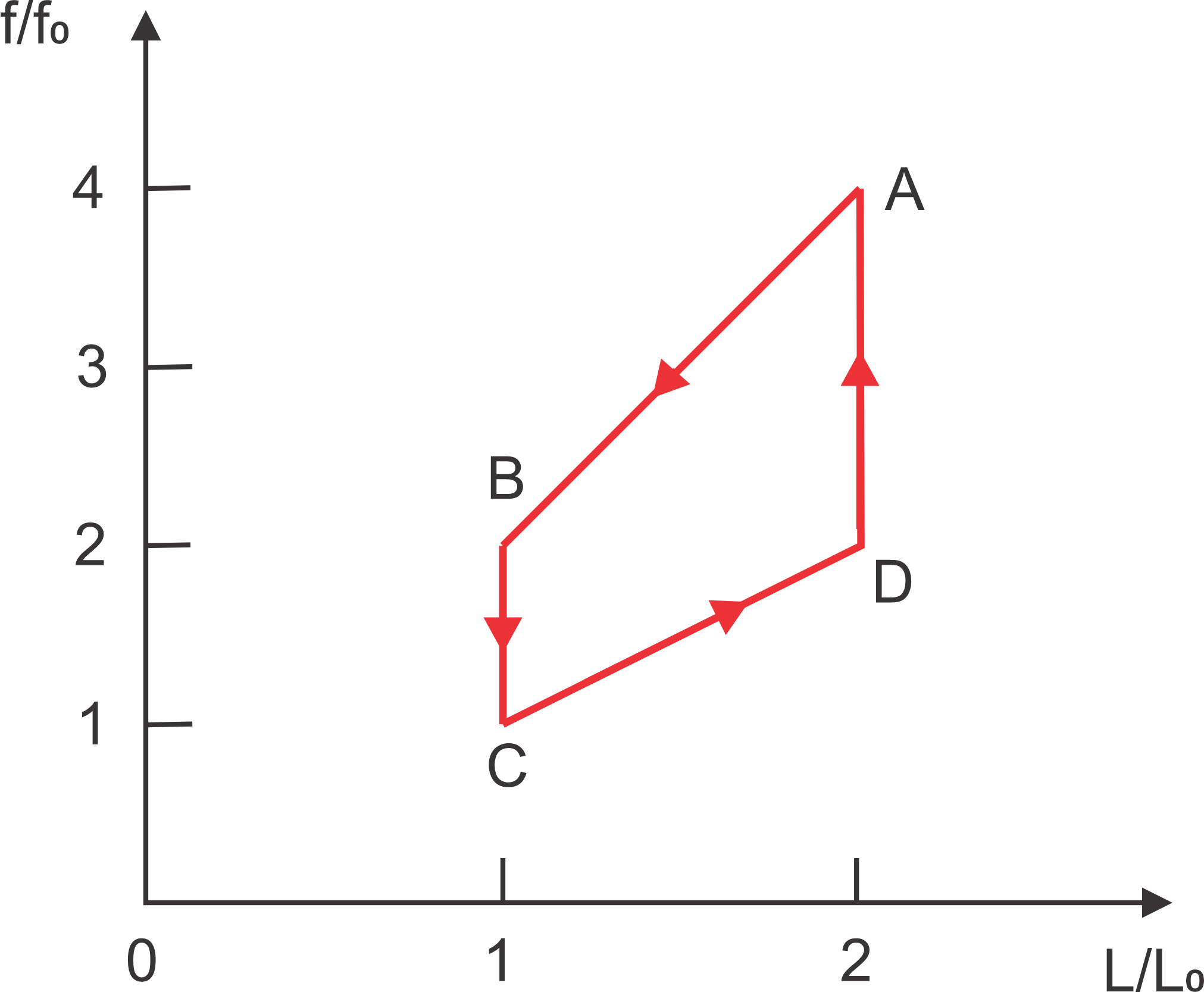
From the figure, find the temperatures at points A, B, C, and D and express them in terms of , , and .
Find the work and heat during the process A B in terms of , , , and .
Find the work and heat during the process B C in terms of , , , and .
Find the work and heat during the process C D in terms of , , , and .
Find the work and heat during the process D A in terms of , , , and .
Find the total work done on the engine during one cycle.
During which of the four processes does the system absorb heat and during which processes does it release heat?
The efficiency of the cycle is defined as work done by the system in one cycle divided by the absorbed heat in one cycle. Compute and express it in terms of , , and .
[Hint: For parts b), c), d), and e) carefully think about what quantities change during the process, and which stay constant.]
Consider a gas of non-interacting, indistinguishable, classical particles in a cubic box of linear size at tenmperature . The particles have non-harmonic energy-momentum relation; the Hamiltonian reads
Calculate the partition function and the free energy [Hint: Work in spherical coordinates.]
Calculate the internal energy and the specific heat at constant volume as functions of .
Calculate the pressure and find the equation of state (relation between ).
Hint: